Care delivery works better, and costs less, when social risk is visible.
Even the best clinical care can be undermined by health-related social needs (HRSN).
With patient- and community-level insights, Socially Determined helps care teams prioritize outreach, align resources to real patient needs, and improve outcomes beyond the exam room.




CASE STUDY
Social risk often hides in unexpected populations. One partner discovered that a large percentage of their 20–29-year-old members were at elevated risk for food insecurity.
$80PMPM
in avoidable costs
What happens when your workflows account for quantifiable barriers to outcomes?
Your care is world class, but a patient’s life is hard to treat.
Clinical data captures what happens in the exam room, but many factors shaping outcomes unfold long before or after a visit.
Surveys offer limited visibility, and patient-reported needs often miss fast-changing realities. When these barriers go unseen, conditions worsen. No-shows increase. Readmissions rise. Disease control slips. Even with excellent care.
Turn insight into coordinated action
With a full understanding of social risk drivers, providers can prioritize outreach, coordinate care, and connect patients to the right resources that improve outcomes.
Reach high-risk patients facing social barriers
Connect patients to community resources
Strengthen care coordination with social risk insights
Focus interventions where they will have the greatest impact on outcomes


Risk-based care requires social health insights.
Increased pressure for providers to adopt risk-based contracts means increased financial and clinical demands.
As providers take on more risk-based contracts, financial and clinical performance increasingly depend on factors outside the exam room. SocialScape data gives care teams a clear view of the social barriers affecting outcomes, and the expertise to identify the interventions that improve health while reducing avoidable cost.









From patient outcomes to financial performance, social risk insights turn assumed risk into measurable reward:
Care management
Identify high-risk patients and prioritize outreach using social and clinical risk insights to support more effective team advocacy.
Readmission reduction
Understand post-discharge factors that interrupt recovery and drive avoidable readmissions.
Value-based care
Improve quality performance and total cost of care by aligning interventions to the social drivers affecting outcomes.
Community Engagement
Identify neighborhoods where focused programs and partnerships can improve outcomes and reduce avoidable utilization.
Chronic disease programs
Address non-clinical barriers affecting control of diabetes, hypertension, COPD, and other chronic conditions.
Risk Contract Performance
Understand how social risk influences utilization patterns and financial performance in risk-based contracts.

Prioritize care management
Give care managers the data they need to identify high-risk patients and personalize outreach.
Strengthen community partnerships
Support partnerships with clear insight into neighborhood-level social needs.
Reduce cost of care
Improve adherence and outcomes by addressing barriers that disrupt treatment plans and follow-up care.
Conditions don’t stop at the encounter. Neither should your
ability
to
act.
When you understand how social risk affects specific conditions, you can prioritize outreach and optimize care transitions.
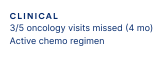
Food insecurity makes diabetes harder to manage. Transportation barriers interrupt follow-up care. Housing instability contributes to NICU admissions and medication non-adherence. All of these are addressable—if you have the right data.

Your platforms. Your workflows. Your choice.
Whether you use SocialScape or integrate our data into your existing platforms, we fit your workflow.
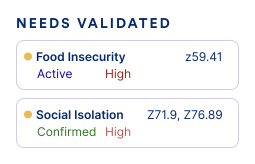

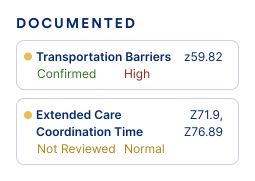


Our person- and community-level insights enhance your care management tools, population health systems, and analytics environments, so your interventions are measurable, scalable, and operationally seamless.